
Draped bustier in purple tulle with reflections of scarab wings
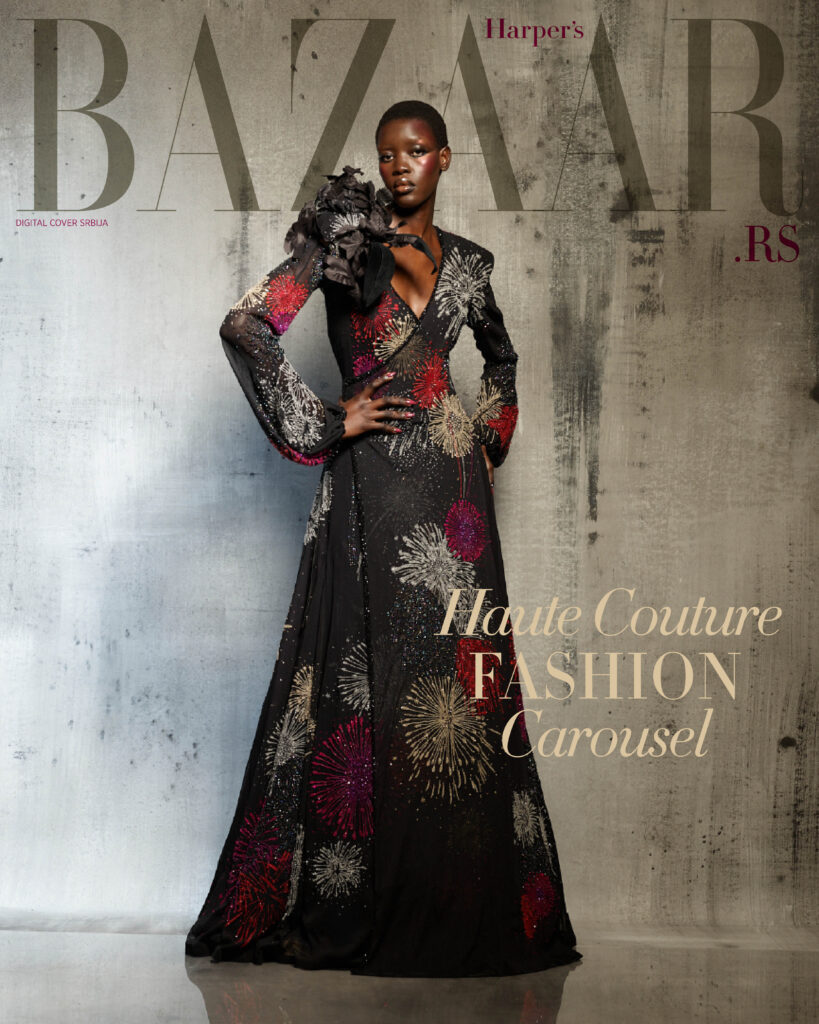
Cross-over kimono dress in black silk tulle with shimmering fireworks embroideries
Od medicine i nauke do sveta visoke mode, put Juliena Fourniéa nije bio klasičan put jednog dizajnera. Sa preciznošću hirurga, razumevanjem ljudskog tela i slobodom umetnika, Fournié je izgradio prepoznatljiv izraz u svetu Haute Couture. Njegove kreacije nisu samo odeća, već skulpture koje istražuju telo, pokret, identitet i emociju.
Nakon iskustva u nekim od najprestižnijih modnih kuća, među kojima su Dior, Givenchy i Jean Paul Gaultier, osnovao je sopstvenu modnu kuću koja danas nosi zvaničnu oznaku Haute Couture. U ovom razgovoru govori o vezi između nauke i kreativnosti, procesu nastanka kolekcije, borbi protiv uniformnosti u modi i o tome zašto prava visoka moda mora ostati prostor slobode i umetničke vizije.
Kakav je bio prelazak iz sveta nauke i medicine u svet kreativnosti i mode? Da li je to bio postepen proces ili je postojao trenutak kada ste shvatili da je moda vaš pravi poziv?
Ja stvaram Haute Couture komade na način na koji hirurg pristupa telu: sa preciznošću, disciplinom i dubokim razumevanjem anatomije. Ne možete izgraditi odeću oko tela ako ne razumete kako se telo kreće, diše i postoji.
Ali moda nikada nije bila moj poziv.
Haute Couture jeste.
Moda se često bavi trendovima. Haute Couture se bavi vizijom, strukturom, zanatom i emocijom. To je mesto gde su moje naučno obrazovanje i moj kreativni instinkt konačno postali jedan jezik.
Kako prepoznajete trenutak kada ideja više nije samo inspiracija, već postaje dovoljno snažna da se pretvori u kolekciju?
Za mene ne postoji dramatičan trenutak kada ideja iznenada postane kolekcija. To je više organski proces. Ona se razvija, menja, insistira.
Mnogi dizajneri provode mnogo vremena definišući temu kolekcije. Naravno, tema je važna. Ali za mene ona nikada nije najvažniji element. Ono što je važno jeste lični, tehnički pristup toj temi.
Jednu temu može deliti više dizajnera. Način na koji je vi krojite, konstruišete, vezete, deformišete i uzdižete, tu počinje autorstvo. Kolekcija postaje stvarna kada tehnika ideji daje sopstveni identitet.
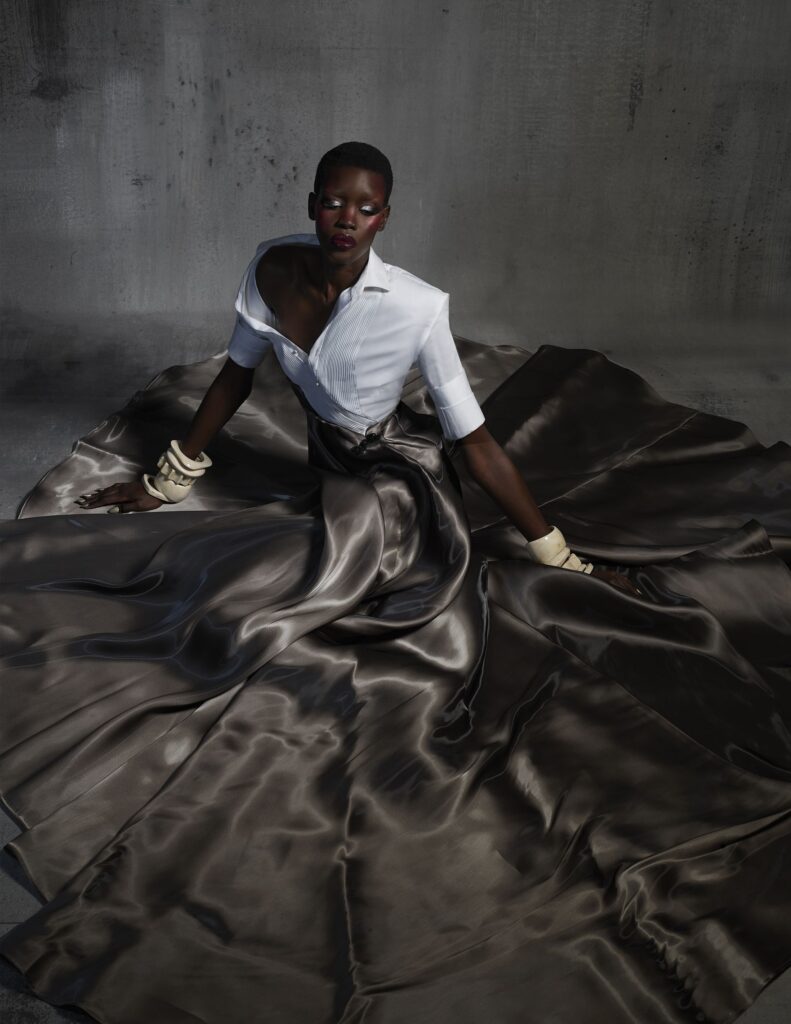
Asymmetrical twisted shirt dress with pleated shitfront in white cotton poplin with a trompe l’oeil effect of a mercury mystery organza skirt
Većina vaših kolekcija nosi prefiks „First“, od „First Circus“ i „First Shield“ do „First Misfits“. Šta za vas simbolizuje ideja prvog koraka, početka i otkrivanja nečeg novog?
Reč „First“ je istovremeno skromna i ambiciozna.
Skromna je zato što je, kada se kolekcija predstavi na pisti, ona i dalje samo početak. Komad sa piste nije konačna reč. To je prototip, predlog, rad u procesu. Odeća zaista postaje potpuna tek kasnije, kada se ponovo izradi za određenu klijentkinju, prilagodi njenom telu, njenom pokretu, njenom prisustvu i završi sa najvišim nivoom preciznosti.
Tada Haute Couture postaje stvarna: ne na pisti, već na osobi koja odluči da živi u njoj.
Ali „First“ je takođe ambiciozan. Svaka kolekcija predstavlja pokušaj da zakoračim u prostor koji je nov za mene, a ponekad i nov za samu Haute Couture. U svojoj poslednjoj kolekciji želeo sam, na primer, da oslobodim vez od teške estetike francuskog Drugog carstva. Istraživao sam mangu, stripove, uličnu umetnost — vizuelne jezike koje stari kodovi visoke mode često odbacuju.
Ali zašto bi ih odbacivali?
Haute Couture ne sme postati muzej sopstvene prošlosti. Ona mora biti dovoljno živa da upija umetničke forme današnjice.
Vaša najnovija kolekcija nosi naziv „First Misfits“, a kroz vaš rad često istražujete teme različitosti, identiteta i nepripadanja. Da li ste se tokom svoje karijere ikada osećali kao autsajder i koliko je taj osećaj uticao na vaš put kao dizajnera?
Zar nismo svi u početku autsajderi?
Svako ljudsko biće je jedinstveno pre nego što ga društvo nauči da se prilagodi. Tragedija je u tome što mnogi ljudi na kraju izaberu sigurnost mase. Prate trendove jer ih to umiruje. Nestaju u istosti jer deluje manje opasno.
Ja ne mogu da podržim tu ideju. Odupirem joj se. Borim se protiv nje.
Za mene svaka kolekcija predstavlja novu borbu: protiv konformizma, protiv straha, protiv ideje da lepota mora da poštuje određeno pravilo.
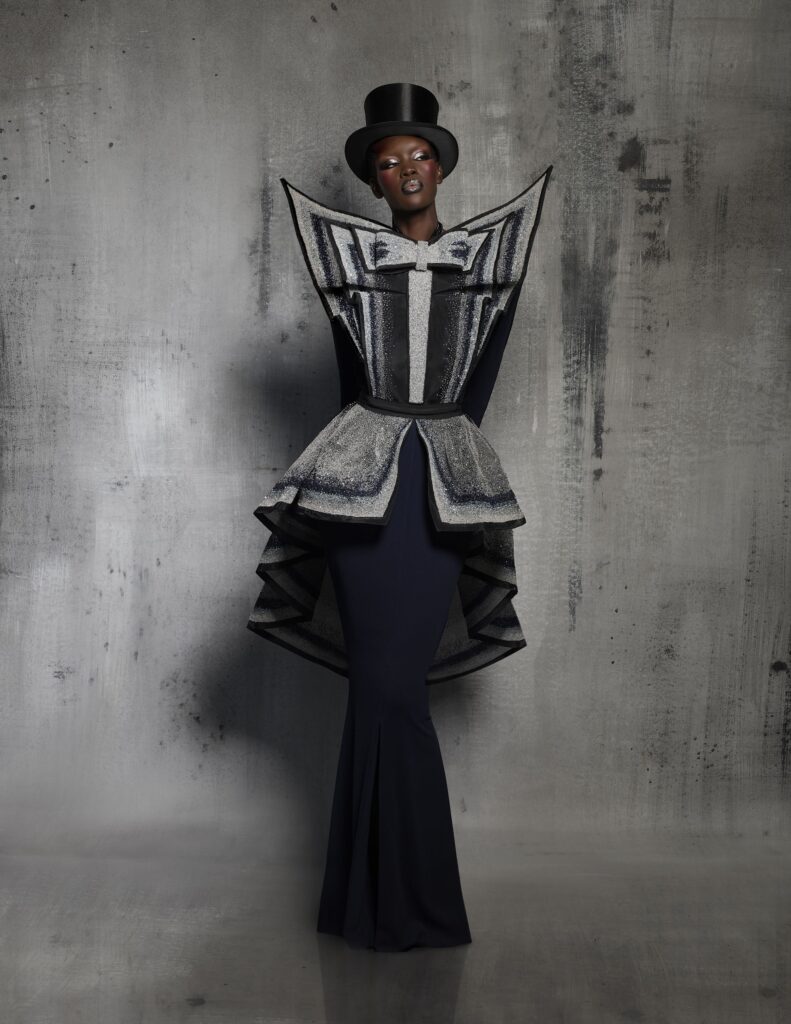
Sheath dress with kimono sleeves in midnight crepe of silk and viscose
Tribute to Klaus Nomi multi-layered bodice and basque in black horsehair embroidered with a gradient of interstellar crystals
Vaš moto glasi: „Norme pružaju sigurnost. Različitost stvara legende.“ U vremenu kada moda često teži uniformnosti, da li je danas teže ostati autentičan i drugačiji?
Izuzetno je teško danas izgraditi Haute Couture kuću i ostati nezavisan.
Vreme kada su kreatori visoke mode zaista upravljali modnim institucijama je prošlo. Moć se pomerila sa kreatora na menadžere brendova. Mnoge kuće sada pripadaju velikim grupacijama i prečesto se identitet brenda žrtvuje pred dva oltara: bukom društvenih mreža i komercijalnom potragom za trendovima.
Dakle, da, teže je nego ikada ostati slobodan. Slobodan da mislite. Slobodan da dizajnirate. Slobodan da napravite ono što vidite u svojoj glavi kao kreator visoke mode.
Velike modne grupacije često pokušavaju da nametnu pravila našim institucijama koja su, po mom mišljenju, nevažna za naš zanat, jer ne znaju kako da procene vrhunski rad ili umetnost Haute Couture. Jednostavno zato što se talenat ne uklapa uredno u poslovni plan. Haute Couture izmiče tabelama i statistikama.
Dakle, da, teško je ne prilagoditi se. Teško je odoleti. Mogu to da radim samo zato što imam neverovatno lojalne Haute Couture klijente koji razumeju da nezavisnost nije marketinški stav. To je posvećenost.
Pre nego što ste osnovali sopstvenu modnu kuću, radili ste u nekim od najvažnijih modnih institucija, uključujući Dior, Givenchy i Jean Paul Gaultier. Koja je najvažnija lekcija koju ste poneli iz tih iskustava i kako su oblikovala vaš lični potpis?
Najvažnija lekcija koju sam naučio jeste: frustracija stvara želju.
Kada radite u Haute Couture studiju kao asistent, vaša uloga je da predlažete rešenja, dizajnerske ideje i tehničke alternative. Donosite mogućnosti za sto. Ali kreator donosi odluku.
Vrlo često izabrano rešenje nije ono koje biste vi sami izabrali. U tom trenutku to može biti frustrirajuće. Ali tokom godina te nagomilane frustracije postaju kreativno gorivo. One stvaraju želju da istražite sve ideje koje su ostale po strani, sva rešenja koja su bila blokirana i sve puteve kojima se nije krenulo. Ta želja je verovatno jedan od razloga zbog kojih na kraju morate da stvorite sopstvenu kuću.
Maison Julien Fournié je jedna od retkih nezavisnih modnih kuća sa zvaničnim statusom Haute Couture. Kako ste doživeli trenutak kada ste dobili to priznanje i šta vam ta titula znači danas, nakon svih godina rada?
To je bio rezultat veoma dugog procesa.
Prošle su godine pre nego što smo prvo prihvaćeni kao gostujući član zvaničnog Haute Couture kalendara. Zatim smo, pre deset godina, postali punopravni član Haute Couture — oznake koju danas zvanično nosi samo deset kuća širom sveta.
Ali Haute Couture oznaka nije nagrada. To je dužnost. Za mene je to priznanje da stvaramo pravu umetnost od tekstilnih materijala: tehnički inovirajući, dok istovremeno poštujemo najviše tradicije zanata, za žene i muškarce koji žive u današnjem svetu.
Naravno da sam bio ponosan kada sam dobio tu oznaku. Ali danas je više vidim kao misiju. U svetu kojim vlada uniformnost, umetnik mora da izrazi ono što lično oseća o društvu, njegovim promenama i da prenese svoje ideje stvarajući emocije. Ako to nije u korenu jedne kuće, onda kućom više ne upravlja stvaranje, već marketinške strategije.
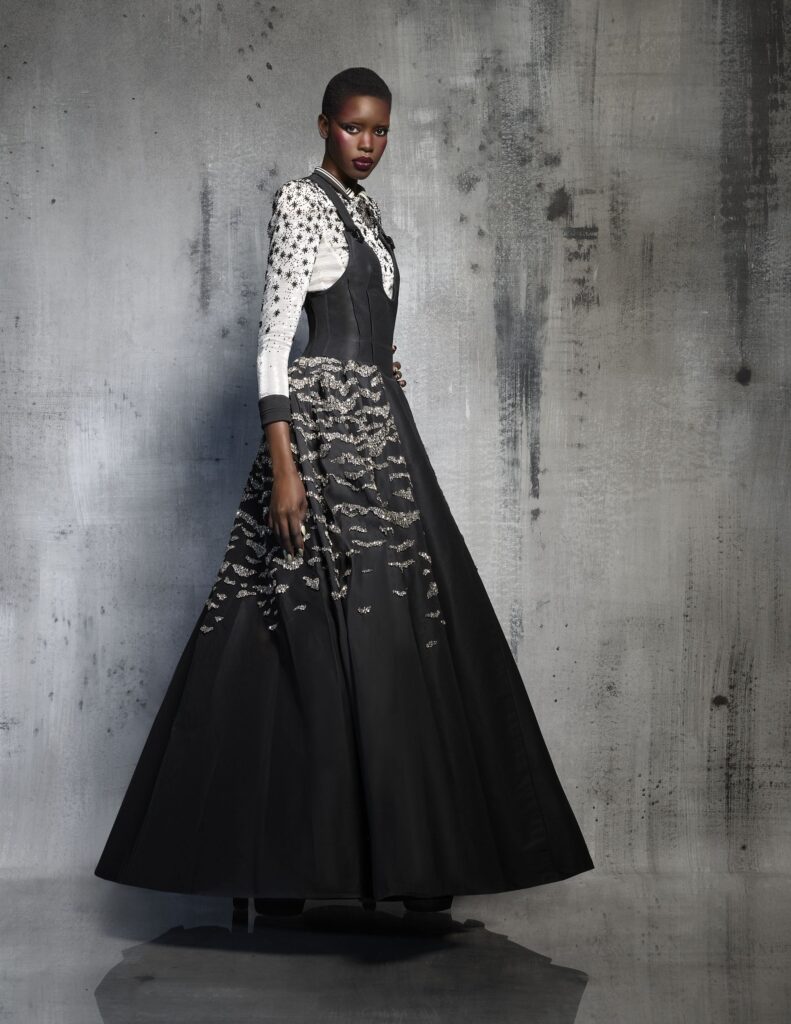
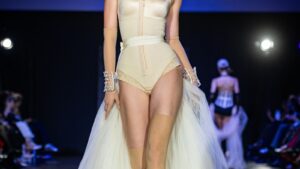
Nude sequin polo bodysuit embroidered with black sparkles and a knit collar
Princess dress in black silk faille embroidered with waves of vintage crystals including an an overall top with signature tuck clasps
Ex-Voto jet brooch
Vaše kreacije nosile su neke od najvećih zvezda sveta, od Madonne i Beyoncé do Lady Gage. Da li postoji umetnik ili javna ličnost sa kojom još niste sarađivali, a čiju biste energiju voleli da pretočite u odeću?
Otvoren sam za saradnju sa pravim umetnicima.
Ali mene ne zanima slava sama po sebi. Potreban mi je pravi dijalog. Potrebno mi je vreme da razumem šta umetnik želi da izrazi, šta želi da otkrije, šta želi da zaštiti i šta želi da njegova slika govori pre nego što uopšte progovori ili zapeva.
Haute Couture izgled nikada ne bi trebalo da bude kostim isporučen slavnoj osobi.
On treba da bude vidljivi oblik unutrašnje energije.
Zato pozdravljam svakog umetnika koji je spreman na takav razgovor.
Kada ste 2020. pokrenuli liniju tašni za širu publiku, da li je to bio način da svet couture-a učinite opipljivijim i dostupnijim ljudima koji nemaju pristup visokoj modi?
Linija tašni je i dalje duboko ukorenjena u Haute Couture.
Ovi komadi izrađeni su u Francuskoj. Jedinstveni su ili proizvedeni u veoma ograničenim serijama. Neki su ukrašeni vezom, neki zahtevaju izuzetno zanatsko umeće, a svi su osmišljeni sa istim nivoom zahtevnosti kao i ostatak kuće.
Naravno, tašna je jeftinija od Haute Couture haljine ili odela. Ali ona je i dalje luksuzni predmet.
Nije bilo reči o tome da couture učinimo jeftinijim. Cilj je bio da više ljudi može da drži deo tog sveta u svojim rukama.
Kada gledate ka budućnosti Maison Julien Fournié, gde biste voleli da kuća bude za deset godina? Koju biste najvažniju zaostavštinu želeli da ostavite?
Za deset godina nadam se da će Maison Julien Fournié i dalje da se bori.
Da se bori protiv komercijalizma. Protiv konzumerizma. Protiv ideje da moda treba samo da proizvodi više proizvoda, više buke i više istosti.
Nasleđe koje želim da ostavim je jednostavno: kada stvarate Haute Couture, slobodni ste da budete umetnik.
A ako ste zaista slobodni, ne sledite pravila.
Vi stvarate svoja.
English here:
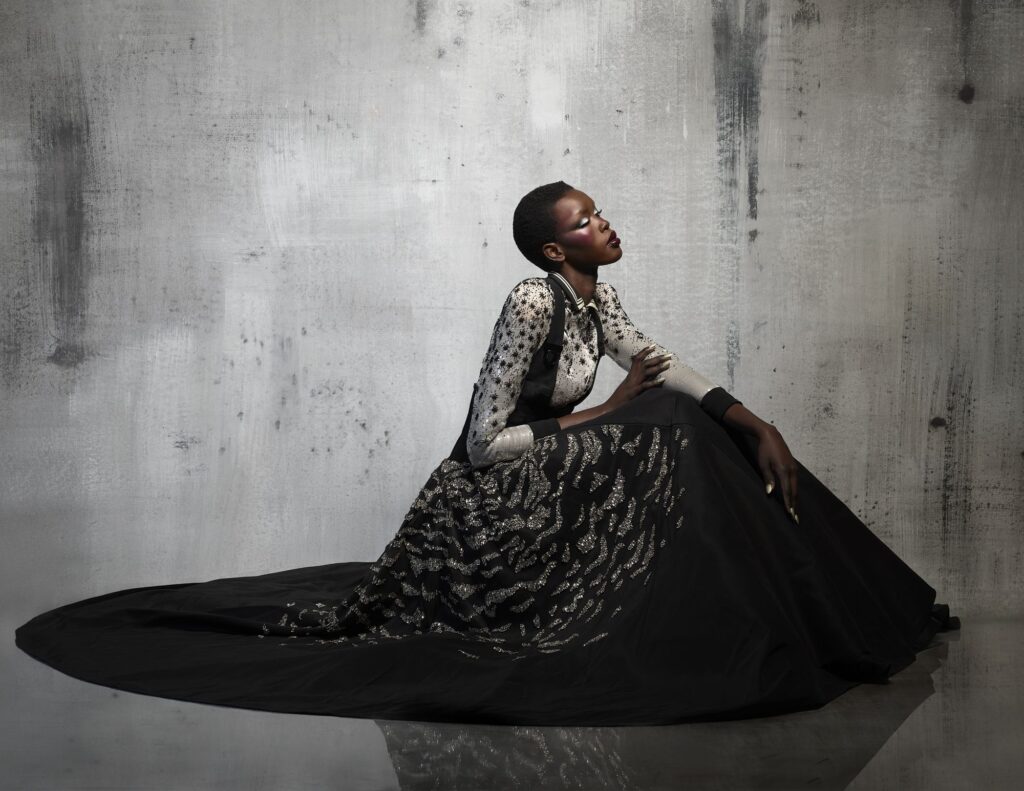
Nude sequin polo bodysuit embroidered with black sparkles and a knit collar
Princess dress in black silk faille embroidered with waves of vintage crystals including an an overall top with signature tuck clasps
Ex-Voto jet brooch
What was the transition like from the world of science and medicine into the world of creativity and fashion? Was it a gradual process, or was there a specific moment when you realized that fashion was your true calling?
I create Haute Couture pieces the way a surgeon approaches the body: with precision, discipline, and a deep understanding of anatomy. You cannot build a garment around the body if you do not understand how the body moves, breathes, and exists.
But fashion was never my calling.
Haute Couture was.
Fashion is often about trends. Haute Couture is about vision, structure, craft, and emotion. It is the place where my scientific background and my creative instinct finally became one language.
How do you recognize the moment when an idea is no longer just an inspiration, but becomes strong enough to be transformed into a collection?
For me, there is no theatrical moment when an idea suddenly becomes a collection. It is much more organic than that. It evolves, it mutates, it insists.
Many designers spend a great deal of time defining the theme of a collection. Of course, a theme matters. But for me, it is never the most important thing. What matters is the personal technical treatment of that theme.
A theme can be shared by many designers. The way you cut it, construct it, embroider it, distort it, elevate it – that is where authorship begins. A collection becomes real when the technique gives the idea its own identity.
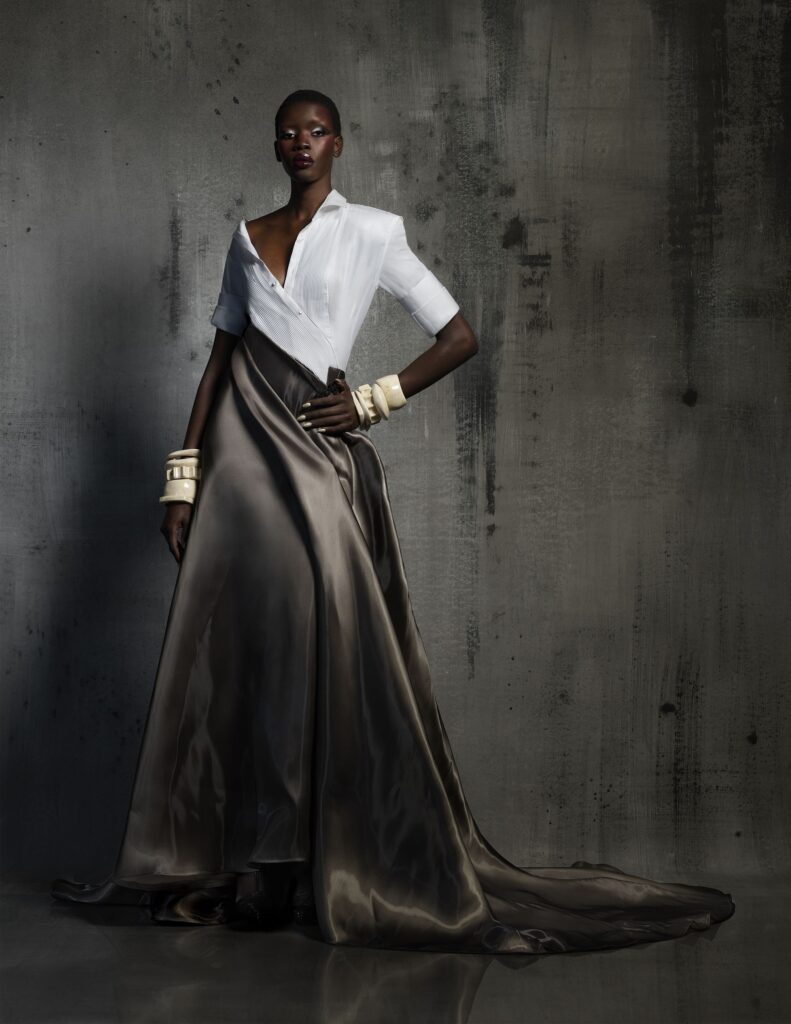
Asymmetrical twisted shirt dress with pleated shitfront in white cotton poplin with a trompe l’oeil effect of a mercury mystery organza skirt
Most of your collections carry the prefix “First”, from “First Circus” and “First Shield” to “First Misfits.” What does this idea of the first step, the beginning, and the discovery of something new symbolize for you?
The word “First” is both humble and ambitious.
It is humble because, when a collection is presented on the runway, it is still a beginning. A runway piece is not the final word. It is a prototype, a proposition, a work in progress. The garment truly becomes complete only later, when it is made again for a specific client, adjusted to her body, her movement, her presence, and finished with the highest level of precision.
That is when Haute Couture becomes real: not on the runway, but on the person who chooses to live in it.
But “First” is also ambitious. Each collection is an attempt to enter a territory that is new to me, and sometimes new to Haute Couture itself. In my last collection for instance, I have wanted to free embroidery from the heavy aesthetics of the French Second Empire. I have explored manga, comics, street art – visual languages that are often dismissed by the old codes of couture.
But why should they be dismissed?
Haute Couture must not become a museum of its own past. It must be alive enough to absorb the art forms of today.
Your latest collection is titled “First Misfits,” and throughout your work you often explore themes of difference, identity, and not belonging. Have you ever felt like an outsider yourself during your career, and how much has that feeling influenced your journey as a designer?
Aren’t we all outsiders at first?
Every human being is unique before society teaches them to conform. The tragedy is that many people eventually choose the safety of the crowd. They follow trends because it reassures them. They disappear into sameness because it feels less dangerous.
I cannot promote that idea. I resist it. I fight it.
And for me, every collection represents a new fight: against conformity, against fear, against the idea that beauty should obey a rule.
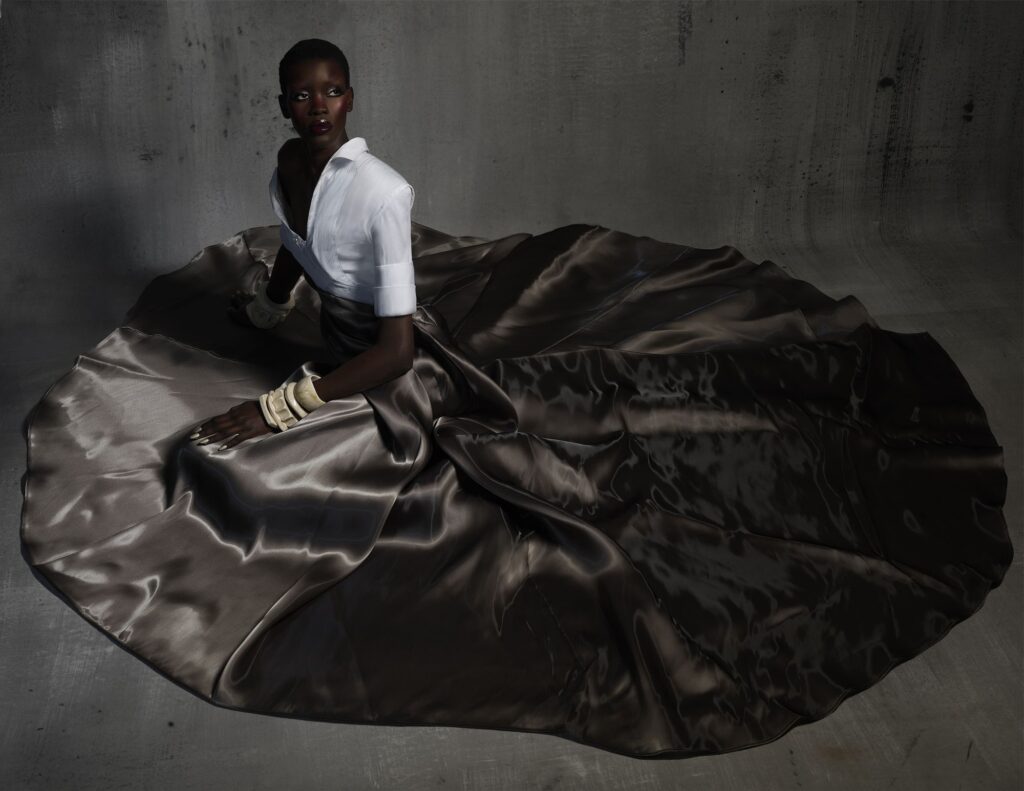
Asymmetrical twisted shirt dress with pleated shitfront in white cotton poplin with a trompe l’oeil effect of a mercury mystery organza skirt
Your motto is: “Norms reassure. Distinctness creates legends.” At a time when fashion often gravitates toward uniformity, is it more challenging than ever today to remain authentic and different?
It is extremely difficult to build a Haute Couture house today and remain independent.
The era when couturiers truly ruled fashion institutions is over. Power has shifted from couturiers to brand managers. Many houses now belong to large groups, and too often, brand identity is sacrificed on two altars: social media noise and the commercial pursuit of trends.
So yes, it is harder than ever to remain free. Free to think. Free to design. Free to make what you see in your head as a couturier.
Large fashion groups often try to impose rules on our institutions which seem to me irrelevant to our craft, because they do not know how to evaluate craftsmanship, or the art of Haute Couture. Simply because talent does not fit neatly into a business plan.
Haute Couture escapes spreadsheets.
So yes, it is hard not to conform. It is hard to resist. I can only do it because I have incredibly loyal Haute Couture clients who understand that independence is not a marketing posture. It is a commitment.
Before founding your own fashion house, you worked at some of the most important fashion institutions, including Dior, Givenchy, and Jean Paul Gaultier. What is the most important lesson you took away from those experiences, and how did they shape your personal signature?
The most important lesson I learned is this: frustration creates desire.
When you work in a Haute Couture studio as an assistant, your role is to propose solutions, design ideas, technical alternatives. You bring possibilities to the table. But the couturier decides.
Very often, the solution chosen is not the one you would have chosen yourself. At the time, this can be frustrating. But over the years, those accumulated frustrations become creative fuel. They create a desire to explore all the ideas that were left aside, all the solutions that were blocked, all the paths that were not taken.
That desire is probably one of the reasons you eventually need to create your own house.
Maison Julien Fournié is one of the rare independent fashion houses to hold the official Haute Couture designation. How did you experience the moment when you received this recognition, and what does this title mean to you today, after all these years of work?
It was the result of a very long process.
It took years before we were first accepted as a guest member on the official Haute Couture calendar. Then, ten years ago, we became a full member of Haute Couture – a designation that only 10 houses worldwide officially hold today.
But the Haute Couture label is not an award.
It is a duty.
For me, it is the recognition that we are creating real art with textile materials: innovating technically while honoring the highest traditions of the craft, for women and men living in the world today.
Of course, I was proud to receive this label. But today I see it more as a mission. In a world ruled by uniformity, an artist must express what he personally feels about society, about its transformation, and convey his ideas creating emotions. If that is not at the root of a house, then the house is no longer led by creation. It is led by marketing strategies.
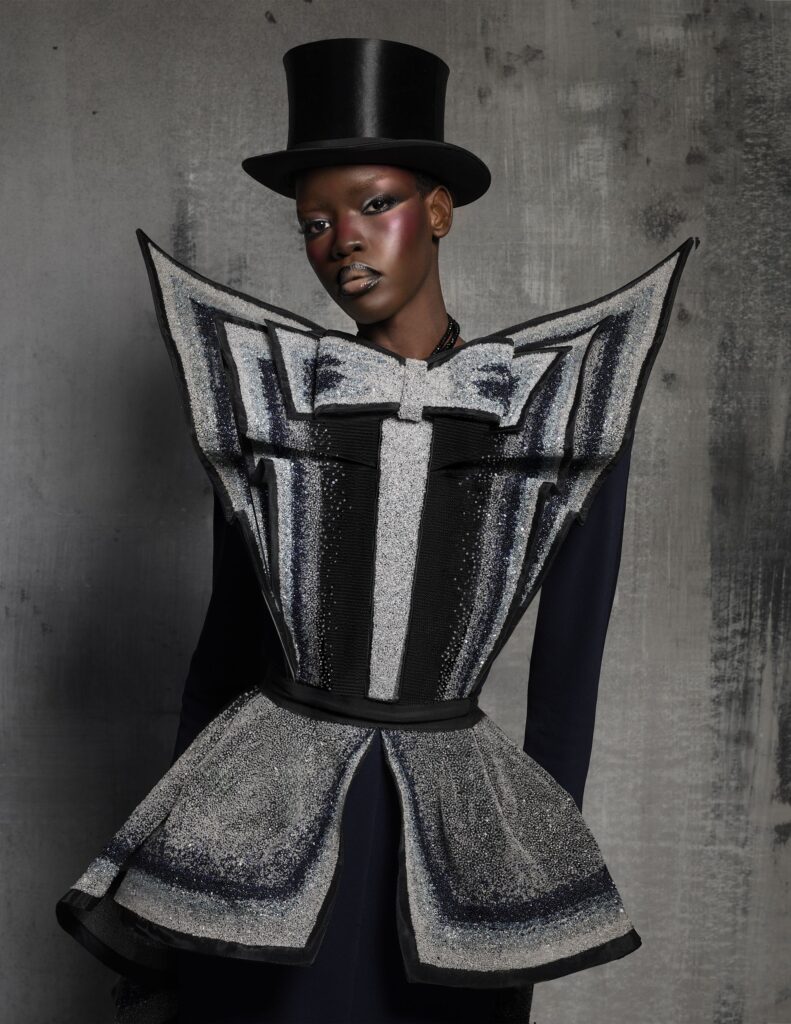
Sheath dress with kimono sleeves in midnight crepe of silk and viscose
Tribute to Klaus Nomi multi-layered bodice and basque in black horsehair embroidered with a gradient of interstellar crystals
Your creations have been worn by some of the biggest stars in the world, from Madonna and Beyoncé to Lady Gaga. Is there an artist or public figure you have not yet collaborated with, but whose energy you would love to translate into clothing?
I am open to collaborating with genuine artists.
But what interests me is not fame by itself. I need a real dialogue. I need time to understand what the artist wants to express, what they want to reveal, what they want to protect, and what they want their image to say before they even speak or sing.
A Haute Couture look should never be a costume delivered to a celebrity.
It should be the visible form of an inner energy.
So I welcome any artist who is ready to have that conversation.
When you launched your handbag line for a wider audience in 2020, was it a way of making the couture universe more tangible and accessible to people who do not have access to haute couture?
The handbag line is still deeply rooted in Haute Couture.
These pieces are made in France. They are one-of-a-kind or produced in ultra-limited editions. Some are embroidered, some require extraordinary craftsmanship, and all of them are conceived with the same level of exigence as the rest of the house.
Of course, a handbag is less expensive than a Haute Couture gown or suit. But it remains a luxury object.
It was not about making couture cheaper. It was about allowing more people to hold a fragment of that universe in their hands.
When you look toward the future of Maison Julien Fournié, where would you like the house to be in ten years? What would you like its most important legacy to be?
In ten years, I hope Maison Julien Fournié will still be fighting.
Fighting against commercialism. Fighting against consumerism. Fighting against the idea that fashion should only produce more products, more noise, more sameness.
The legacy I want to leave is simple: when you create Haute Couture, you are free to be an artist.
And if you are truly free, you do not follow rules.
You create your own.
Team credits:
Haute Couture Designer: Julien Fournié @julienfournie
Talent: Ayak Veronica Bior @officially_ayak @newyorkmodels
Photographer: Tom Marvel @tommarvelphotography
Casting: Anna-Maria La Germaine @anna_lagermaine_private with Fashion Politique
@fashionpolitique
Creative Director: Cannon @thecannonmediagroup with Atelier Management
@ateliermgmt
Hair Stylist: Lihn Nguyen @linhhair with SEE Management @seemanagement using
Redken @redken
Make Up: Romero Jennings @romerojennings with AKC Creative Studio
@akccreativestudio using M.A.C Cosmetics @maccosmetics
Nails: Frances Liang @purplenailbox with Atelier Management @ateliermgmt using
Kokoist @kokoistusa
Production: Winnie Paranoan @winnie_noan
Lighting Director: Murat Ozdemir @1muratozdemir1
Videographer: Edsta @edsta
Digital Tech: David Gannon @davidgannonphotography
Grip: George Pepe @gspepe